Writers Wanted

Our writing group is looking for writers who are interested in submitting short stories to our Thieves World project.  This project is crafting short stories that are set in the Thieves World universe.  All short stories must obey the rules set forth by Robert Asprin.  However, we have added an addendum.  Complete rules will be provided when accepted into the project.  Everyone who is accepted to the project must cross link to everyone else’s stories.  Cross Linking will not only help promote the Thieves World stories but will also promote your blog.  A bonus for everyone.

If you are interested, please contact Kevin Pajak for more details.  Writers must submit a story of no more than 10,000 words from their portfolio for review.   The story submitted must be a fantasy story.

Or to learn more please click here https://kevinpajakwrites.wordpress.com/contributors-wanted/

Posted in fantasy, Short Story, Thieves World | Tagged , , , , | Leave a comment

Publishing

Recently I was hired to be the Publisher for Dark Age Press. http://www.darkagepress.com

It is interesting being the publisher as well as a writer. Of course, Dark Age Press won’t be publishing anything that I write. That is okay. What is exciting is seeing all of the new and hopeful authors submit their works. I am on the back end of the publishing which means that I mostly deal with the business aspects. The submissions group reads the stuff and the editors edit the stuff. Mean while, I get to work with contracts, bookstores, advertising, authors, artists, libraries, malls, and any other place an author may desire to host a book signing event. Wooop! Still, it is an interesting challenge.

On occasion, I am asked to read a submission to give my two cents. Mostly, I do not get to see the books until the ONE has been selected. That one is the one I review. I may send notes down to the editors or may discuss the book with submissions department. I am the final say on all things. Seriously, I don’t have time to poke around with all of the submissions. I barely have time, and I have to shove things out of my calendar to do so, to read the one that the group thinks is the best for publishing from either the January or the August open submissions months.

I dread the day that agents start coming to my door. That will mean even more work for me. Sigh… I may have to hire someone — NOT yet however. I do think that we will have to hire more submissions people and maybe a marketing person to help advertise our authors’ books. We are still small.

Sadly, the book we chose from the January submission backed out. And that was after we put a lot of effort into his book. Perhaps, he will submit it in the future when he thinks he will have time to edit it into shape.

That is one thing that the editors constantly complain about. It seems all authors think their books do not need editing. I will tell you right now–they do. Even if it is perfect, this publishing house or that one has a unique style and outlook on what makes a great book. Thus, they will want changes here or there. It is the bad publisher whose edits actually change the novel for no reason. If there is a purpose, then that is fine.

Take for instance, the author who we just worked with. We told him that the main secondary character could not die. Why? Because it would ruin the overall effect of the structure of the story. The foundation and the general structure (language use, description, scene, setting, plot–basically everything) said that the main secondary character could not die. Maybe, he stepped away because we demanded that this did not happen. If so, he lied and said he was too busy. We want the best book and if that means changes, then that is okay.

I do demand to keep the integrity and overall vision of the author. If this cannot happen, then the novel is probably not one we should publish.

Ah well, back to the grind stone. I have another bookstore that needs me.

See you in the pages,

Kevin Pajak

Posted in Uncategorized | Tagged , , , , | Leave a comment

Reactive Vs. Proactive

Recently, I started reading the book “The Game Master’s Handbook of Proactive Roleplaying” by Jonah and Tristan Fishel. From the start, it discusses low quality GMing (or as I put it DMing). This made me think about characters and character generation. It made me think about how the plot and the story arc proceeds. Indeed, this topic needs to be delved into. So, let us start.

The typical writer begins a story by conceptualizing an idea about a story in general. The general or generic concept gives rise to the overall plot of the story. This is where the writer begins to envision the characters who (Notice I did not say that. That is reserved for things. Who is reserved for people.) will populate this world. Should my protagonist be male or female. The author then decides X. We will go with male. Why? Because I am a dude. Endofstory. (yes I know the spaces are missing). Endofstory.

What is the outlook of the character? What will he be like? Does he have any idiosyncrasies? What is is goal? These and other questions lead to the author (not all the time, but often) to generate a character bio. This is good. The character bio allows the writer to understand who the main character is. It allows the writer to keep the protagonist grounded. If there is some version of the character written down, it becomes less likely that a writer will deveate from who is first incepted. Now, the author begins crafting the protagonist’s secondary companions. Again, the process plays out until the panoply of characters is complete. What happens next?

EXPOSITION –> The aurthor begins crafting the story, and we are off to the races. Start of the story. Scene description. Action happens. Perhaps not the action that begins the RISING ACTION but action nonetheless. Timmy got on his bike and rode to the corner store. What is the neighborhood street like? Who is on the street? Maybe, the street is empty. Why is it empty? Because Timmy’s bike rides between dimensions and thus he never sees anyone while riding his bike. His dad is a super scientist and created this bike for him so he would be safe while riding it. Then, THE action happens that starts the RISING action.

RISING ACTION –> Here is where the main portion of the story usually happens. Not always, okay…geesh. Touchy are we. Action and reaction happen over and over until CLIMAX occurs. No problem. The author has already scripted out COMPLETELY what will occur through out the whole story. This type of writer is called a PLOTTER. No problem. Many of us writers are PLOTTERS. Everything is already scripted out for the characters. The author even knows about the bad ending awaiting the evil baddie boo. (And yes! That is a real term. Just look it up in Kevin Pajak’s “Big Book of Unusual and Unused terms. Available at finer bookstores around the nation. If your bookstore does not carry it, just ask them to get it). Poor Baddie Boo, he/she/it never comes to a good end. Yes, it can be a Big Baddie Boo. Just think of Twister (sigh…okay Twisters if you want a second tier movie). The tornado is the evil Big Baddie Boo.

So, we all know about everything I just wrote about. Fine. But why this blog post? What I just wrote about is Reactive Writing. Plotters are REACTIVE writers. Their characters react to situations. Who and what is the opposite of a Plotter? These people are called PANTSERS. Why? Because they fly by the seat of their pants when writing. They are Proactive writers. They take their story and do not script it out but let it come to them as it will. Take for instance my current story I am crafting. I intended to write only on the first book. BUT what ended up happening was that I am now writing on the fourth book WITHOUT having even written the first book. Okay, sure, I do have an over arching plot for the seiries. But, as a Proactive writer, I let the story and the characters tell me what is happening. This can be quite unnerving for PLOTTERS. They need the security of having everything already set out EVEN BEFORE THEY BEGIN WRITTING.

There is a price to pay for being a REACTIVE writer. This type of writer misses out on those gems that can occur when you fly by the seat of your pants and just write whatever comes to mind. As of yet, I have not had charcters talk to me, but I have heard that they do. Proactive writing opens up the field of the story and CAN (not does but CAN) allow for those unexpected gems to flower. In many ways, the Proactive writer allows the characters and setting and scene to control the story. More often than not I do not even know what I will write next. I feel a comfort flow into my very being when I do not dominate and control my characters. Heck! I don’t even control the setting. I let it tell me what it is. And, don’t even get me started on the scene. Gesh. What a pushy gal she is.

In the end, Proactive writing allows the characters to do what they need to do and do what they want to do. Is there any stability in doing it this way? With glee I say No. This is great. I want the characters to do what they want to do. This makes for better story telling. Yes, it is more “sloppy”, but this can be cleaned up during the editing process. I even had a male protagonist, but by the end of the story he became a female and I had to go back and revise the story so that from the beginning, the protagonist was female. No, I don’t mean transgeneder. I mean it was a female from the opening of the story.

I believe that letting the characters have breathing room brings life to them. Even Plotters can bennifit from allowing Proactive writing to occur from time to time. Yes, they craft more constrained stories, but giving their characters some leeway would definetly bennifit their writing. I am NOT saying that Plotters can’t write. What I am saying is that EVERYONE should try Proactive writing from time to time Or when the situation warrants it.

This dynamic style of writing feels good. I do not constantly dominate and control my characters. So, writing for me is just that much more enjoyable. I would suggest reading “The Game Master’s Handbook of Proactive Roleplaying” for more information. Since I am already a Proactive DM, this book did not contain much that I do not already do. But most DMs and most GMs tend to be Reactive DMs. They WILL find this book invaluable.

Posted in Uncategorized | Tagged , , , , | Leave a comment

Recursive Plex

The contextual visuals relate to the overall structure dynamic across the spectrum of displacement. In as such as the connective linear forces draw across the temperament of the inverse properties to give the overall structure a dynamic modality that results in various forces unifying into a singular plex. It is the plex that allows the system to afford redundancies in the retrograde of affordable inconsistencies. It is redoubtable that these crosscurrents can adapt to the systematic structure. Thus, investiture in a recursive reduction proves vital should we defer to alternatives, then an overall capture of essential currents can be had.

Thus, the overall structure tends towards stasis only if the quantum levels of structure can be unified. Indeed gentlemen, manufacturing of the node can progress if the structures hold firm. I contend that integration of the new system proceeds apace and will continue to do so as long as the fundament holds. The processing plant is in full operation and will be on line upon insertion of the molecular modalities. We have, dare I say it, achieved uni-plex before the moment of disillusionment perfected.

And a great cheer went up across the complex as harbinger of potentialities arrived.

Posted in Uncategorized | Leave a comment

Centrality

As I work on my fantasy series, I think about the central nature of the protagonist and how the story pivots around the pole of his being. Can a story have more than one pole, one essence, one essential nature? If not, then does that mean that each book/novel/story is a singular entity with the cast of characters and events playing out across the spectrum of his being? If we look at the novel as a living entity what do we see. Words at play with themselves as an unfolding. But they do more. These words, in their arrangement, enter into the reader in ways that encounter The Other [sic] as an extending out toward. Unlike human to human interaction, in this case, it is words’ textualness extending out toward the reader/being/entity who is open. It is this openness that comports the reader as The Other toward himself. He can only see these words as a reflecting back upon himself. It is this recursive nature of reading that brings us to ourselves. However, it is an uncanniness that we encounter because the murmur of the author is also at play in the language of the story.

This is why one author is prized while another is not.

When it is a recursive reflecting splayed out across our being, we get a delving into ourselves that is not possible in any other fashion. This is the gift that the writer writes to us. We are given a piece of ourselves by the author in a timelessness (that is here the novel resides–outside of time) that ripples ever outward in the liquid play of language.

So, I return to the protagonist. Can stories have a multiplicity of protagonists? Can there be chaos? OR does it/the novel have to always have a focus of individuality? It seems to me that in the current accepted structure there can only be one protagonist. It is his/her/their/our/we/us story. Individualized and compartmentalized – the story is a singular being living out its days in the multiplicity of interpretations.

It is this oneness that allows it to become many to us as we change and grow. We re-read it again and again, seeing facets gone unnoticed until now…now..now. The now of the re-read. If there were multiple or a multiplicity of protagonists where would the agent and agency be?

I think I agree that each story can/should/may only have one protagonist with a panoply of others as supporting identities (Ref: Carl Jung archetypes in the psyche) of the singular being. Is it then the case that the totality of all things occurring in the novel are in fact merely facets of one person? That even the antagonist is merely another identity of the protagonist? Is Moriarty merely Holmes as an emergence of a different facet of the self?

Possibly,

Still, we do crave texts that sing to us across the distance of language at play. That is good writing.

Posted in Uncategorized | Leave a comment

Heroine’s Journey

Here is a great blog for the Heroine’s Journey

https://heroinejourneys.com/

Posted in Uncategorized | Leave a comment

Artistry in the Cover

I recently had a chance at FenCon 2023 to talk to an independent publisher who crafted his own covers. There is something to be said for saving money on art. He does because he creates them himself. We all know that the publishing world has to watch costs if it is going to make a profit. This goes for the big boys too. Everyone in the publishing field, which also includes authors, understands profit margins are tight. There is not a lot of extra cash just flowing out of a spigot. We get it. My take away from meeting and discussing cover art with this publisher is that publishers believe art is one place where cuts can be made. Hell, artists are expensive. Who can afford that?! The better question is, “Should we?”

The answer is forth coming, but first I will return to a discussion of this publisher’s line of books. Taking a look at a series, sure they should and indeed must have the same or similar look and feel. I get it. The reader wants to pick up a book in that series and see that the cover is cousin to the last book. I want that as well. Well friends, this publisher understood that when he crafted a series. Each book in that series has the same look and feel that the other do. This is called… wait for it… unity. That is right. If there is a unity to the whole series, the way the characters act, the situations that occur, the evil-doers’ (borrowing a phrase from ole Bushie) actions, basically everything must contain a unity that unifies the series. This includes the cover art. Dark drafty castle with bold colors does not match child like art with bright sky and fluffy clouds. Thus, each cover should feed off the last cover for inspiration and design.

What publishers do not seem to understand is that this can also be used to great benefit. If the story takes a drastic turn, let’s say the author has written himself into a corner and he needs to reorient the story to get out of it, well… that is easy. Change the cover of the series to reflect that this particular tale veers off the beaten path. The cover is the first line of defense in ensuring that the readers will be willing to still take that journey down the series path. I do not see publishers taking advantage of this aspect of the publishing industry. Maybe they are scared. Regardless, most always we see a series maintain unity by keeping a similar feel to the cover art. I reference Stephen R. Donaldson’s “Covenant Series”. Have you see the paper backs? A-May-Zing! Each one is a different color but they still maintain the same style. Perfection on paper. Great job big publishing house whose name I don’t know. I think it was Bantam-Del-Double Day-Person-Prentice Hall or some such name. You know how they love to gobble up companies but still keep the names. Maybe call them Bloat and be done with it. Pha! Anyway, back to it. Where was I? Oh, yes—Art.

So, I started analyzing the other covers that the publisher had. There were a few series but there were also some one offs. The startling thing I came to realize is that ALL and I mean ALL the covers had the same look and feel. The overall experience of looking at them made them feel as if they were in fact the same series, which they were not. So, how does a reader react?

If the tale is good, it is good regardless of the cover, yes? If that is true, then why doesn’t the publishing world simply publish books with white covers and black letters with the title of the book and the author’s name? Why? I will tell you why. The art on the cover sparks the imagination. It is the beginning of the journey that the reader takes. I myself will dump a book because the art sucks. Tolkien? Yeah, I’ve heard of him, but he’s not worth reading. Have you seen that crappy cover? Yuck! Okay, maybe not, but you get the idea. It could be the best tale ever told in the last ten years (notice how I limited it to ten years? Wink.), but if the cover sucks, I won’t be purchasing it. Sure, others might tell me all the great stuff going on in the book. I might even purchase it on a lark when I find it at a garage sale or at half price books, if there is enough hype about it. This fact does nothing to help the publishing world. It does not thrive off garage sales. It needs sales. Are we starting to see how important the cover is? Oh sure, there are some great greats out there that ignore cover art. I will mention that insanely awesome cover for Catcher in the Rye. That cover purple/magenta/whatever with simple yellow letters. That is a great cover for that novel. I wouldn’t have any other one. The latest space opera novel needs a great cover. Don’t you agree?

I return to my publisher. I didn’t want to bag on him at the Con either directly or to others attending the Con, but I will here. Sure, he is proud of his books. Even better, he is making sales. A hearty high five for him. I also point out that everything matters. So, if you have all these same styles pumping out, what kind of authors will you attract? I know that I would NOT approach him to see if he would publish my book. Heck no. He didn’t get it that the authors he attracts are authors who are either desperate or who are attracted to the covers.

I took a look around at other publishers. They have variety. Literary Fiction, Fantasy, Sci-Fi, Mystery… they all have a different feel. I am not one to demand that Mystery novels have murder covers or that Fantasy should have nothing but dragons on the cover. What a publisher needs to consider is what will each genre’s feel be for that publisher? Will the same artist be used for that genre? I think that making your genre have the same feel as EVERY OTHER PUBLISHER is also stupid. Sure, murder mystery authors want XYZ, but that does not mean we should accommodate them.

If we can take two things away from this crazy discussion we will see that one, and this is a major number one so I will repeat it, one! Artists do matter and they should be hired, and try to hire one not because he or she is famous, but because you like that style or feel or whatever makes you attracted to that artist. Hiring them just because they are famous is stupid. I would argue even more stupid than having every cover similar. Two, and this is almost as important as one, two..do not get trapped into thinking that your genre has to match a certain style or feel just because other publishers are doing the same thing. This is the United States of America. We invented individuality. We should adhere to that simple lesson and create a uniqueness about all that we as Americans do. This includes the covers we make. Sure, it might be scary, but think of the amazing covers we will have if we take the plunge and give a measure of freedom to the artist and the author. Wow!

Posted in Uncategorized | Leave a comment

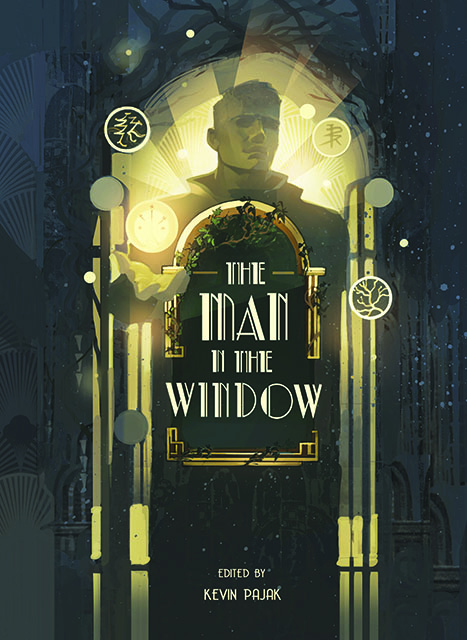
Man in the Window

The literary fiction short story anthology that our writing group has been working on for fifteen years is finally published.

You can find it on Amazon by clicking this link. https://www.amazon.com/Man-Window-Kevin-Pajak/dp/1737430509

I would love to hear feedback after reading it. Let me know what you think. If anyone wants to do a book review of it, I would love it — good or bad.

Such effort, all those years, phew! I don’t know how it affects other authors when they finish their books, but it left a gap or hole in me. I turn and turn and look for The Man in the Window, but then realize it is done. After reorienting myself, I realize I have to learn how to write novel length stories. A whole new way of thinking. The three thousand word limit became… comfortable. It was like a broken-in housecoat that you wrap around yourself while sitting in your favorite chair. <Click> the gentle light from a reading lamp turns on and you sit with your steaming cup of tea and a good book. Ahhhh… all is good. BAM! the world you lived in for fifteen years explodes in all directions and you are floating in a void. Really, a void? Yep. How do I go about changing how I write so novels come into being? One keystroke at a time? Sure, they tell that to recovering alcoholics. What about me? In a way, I too was addicted. Addicted to the length and rhythm of the short — very short — story. How long is a chapter? Should I take time to do a lengthy description? Oh yes, character development. Oh hell, here comes dialogue.

As I sit here in the aftershocks of the completion of our fifteen year project, I float and think about what comes next. It will be groovy to go on this new journey that expands my story world to 120,000 words instead of a mere 3,000. What awaits?

Well, I am working on a fantasy series. Twelve books. Unlike those who live by writing, I write so I can live. I will finish at least three of the books before I seek publication if not the whole series. It should become easier with practice. I should have a handle on it by the end of book three. I hope I can pick up the pace and finish it before the next Mayan calendar runs out.

I hate it when authors start a series and then die before they finish. You know who I mean. I don’t want to do that to my readers. So… here is to writing faster.

I hope you enjoy The Man in the Window. I love the preface to the authors’ notes. The rest is pretty good, too. Thank you, Kevin.

Posted in Uncategorized | Leave a comment

Nifty Size Chart

Here is a website that allows you to visually compare sizes of things. This could come in handy for many things. One person could stand in for a building size and the other would be your actual person. “Hey, Maude, how tall was that mountain?” Well, friends, now you can check. Try it out.

https://www.heightcomparison.com/

Posted in Uncategorized | Leave a comment

Trust Me

I recently re-read one of our writing group’s author’s story. It is called “Coda Redux.” James, the author, discusses in his author’s notes about trust, which made me want to discuss this concept in my blog, as I did not see him cover it to my satisfaction. So, let us turn to a discussion of trust.

How does an author construct a character’s trust that is believable? What is trust and what comprises it? Psychological construction of trust in a character contains ordered indicators that lead to a conclusion in the character that trust is warranted. In other words, for a character to believably trust someone who should not automatically be given trust, there are a number of indicators which are arranged in order. When these indicators pass the test as being true, then a piece of trust is earned or given. At some point, the character will give trust. However, the less likely it is that a person should be trusted, then the more indicators will need to be proven true (or passed) before that trust is given.

Here is an example

The Principle:

Say a mother goes to an elementary school and goes to the principle’s office. A woman enters (indicator 1 = yes) Note: a woman principle is more likely to be trusted than a man principle. If it were a man, then the answer would equal “maybe.” The woman, who this mother has never met, is clean, smells good, and is pleasant looking. (indicator 2 = yes). The “principle” (I put it in quotes because we do not REALLY know if this is the principle.) asks the mother to sit down. After a pleasant greeting, the principle says that she is worried about her son. (indicator 3 = yes). The mother will more likely trust someone in authority if that someone seems to be attempting to help her son. If on the other hand, the principle says, “Your son is a trouble maker,” then the mother will become defensive. In this case, (indicator 3 = maybe). Such a simple concept. What if we move it over to a less simple concept?

The Detective:

A mother opens the door to her house and two detectives are standing there. (Note: having only one detective will make it more difficult for the mother to trust) She shows a badge which seems real. (indicator 1= yes). The detective is shown into the living room and sits down. The detective immediately starts attacking her son. (indicator 2 = No). Instead, the detective starts asking questions about the mother, then switches to the son. (indicator 2 = yes)

Remember: these are “most likely” scenarios. I cannot craft them properly without an actual story to analyze. All these things will have to be built by the author. Subtle details will help perfect in a “yes”. Clean clothes, smells nice, combed hair. But the dirty bum living in a cardboard box will not ring with truth if his hair is combed and washed. So, some factors will automatically be against you when trying to craft an unbelievable person for a character to trust. Likewise, remember that you can craft a totally trustworthy person and insert odd or unsettling indicators in that person so that trust is less likely. This helps throw the reader off. Example: the detective who was acting odd, fidgeting when I said my husband’s name. The scientist who laughed maniacally when she talked about children being safe. The colonel who requires inappropriate actions be taken.

In the end, this topic is so broad that it becomes needful to write a whole book on trust. Needless to say, most authors have enough life experience that they can craft most of the characters properly. We just need to remember to check each indicator box along the way. If further research is needed, there are many psychology books written on the subject. This post stands mostly as a reminder that believable trust needs to be earned by verifying “yes” along the way. Of course, you trust me? don’t you?

Posted in Uncategorized | Leave a comment